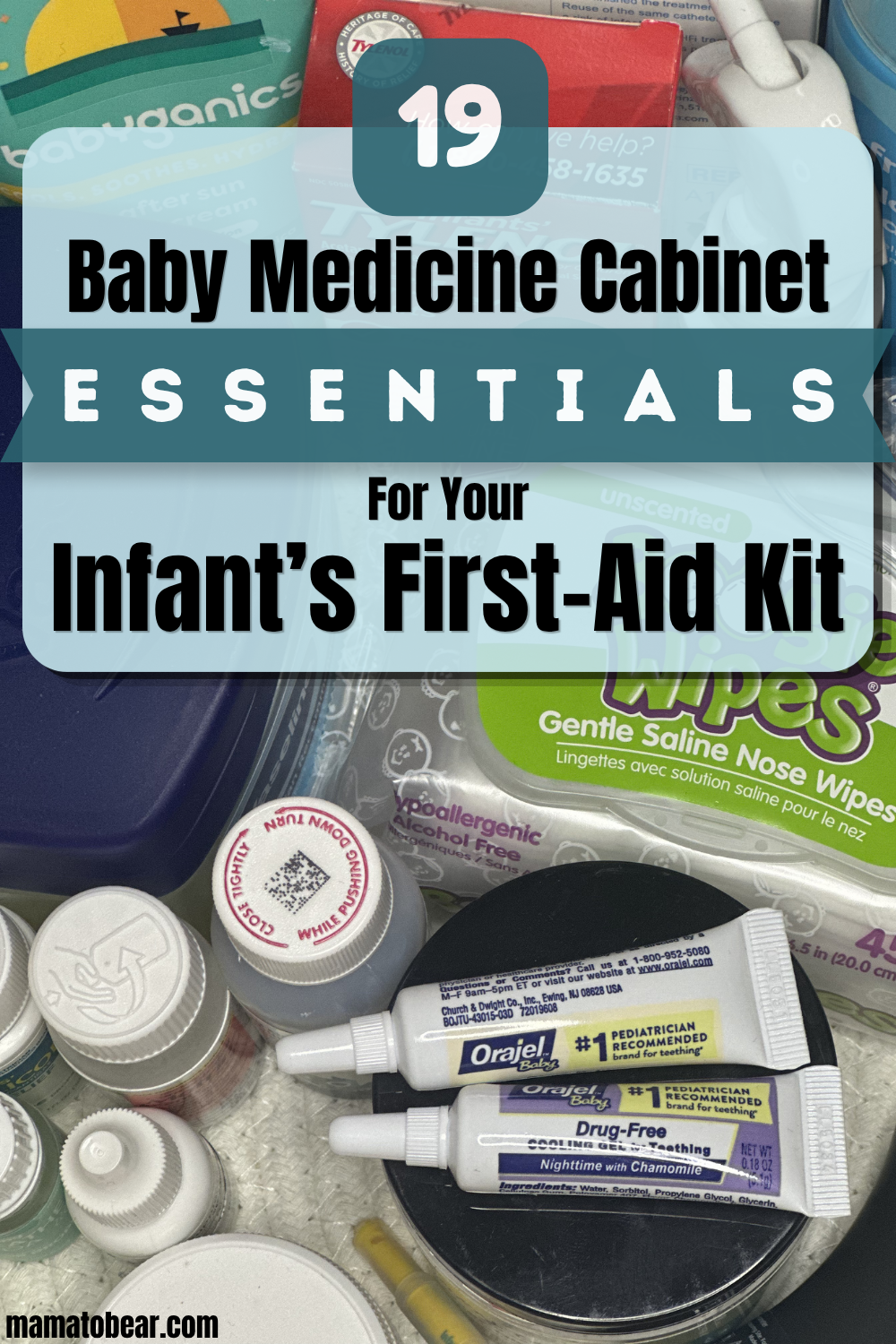
When I was putting together our baby registry, I wanted to feel prepared for the moment our baby inevitably got his first cold, fever, or upset tummy. Truthfully, I had no real-world experience and no idea what actually belonged in an infant first aid kit.
After going through those early sick days, I quickly learned what was essential and what was a waste of my time.
If you’re building your baby registry or just want to be prepared, here are 19 baby medicine cabinet essentials every parent should have in their infant first aid kit.
Listed below are 19 baby medicine cabinet essentials for your infant’s first aid kit, followed by an expounded list.
- Tylenol (acetaminophen)
- Motrin (ibuprofen)
- Mylicon Drops (simethicone)
- Infant Cough Syrup
- Orajel Drops (without benzocaine)
- Vitamin D Drops (if breastfeeding)
- Nasal Aspirator
- Nebulizer (& Saline Spray)
- Boogie Wipes
- Humidifier
- Vapor Drops
- Chest Rub
- Diaper Rash Cream
- Baby Aloe
- Skin Ointment
- Windi Gasspassers
- Digital Thermometer
- Vaseline
Over-The-Counter Medicine
These are the most important over-the-counter baby medicine essentials to keep in your infant first aid kit. Always consult your pediatrician before giving your baby any medication, especially under 6 months of age.

Infants’ Tylenol (acetaminophen) – Used to relieve minor aches, pains, and fever. I personally use the dye-free formulation. This should generally not be used for infants under 6 months unless your pediatrician states otherwise. Most pediatricians will OK the use of Tylenol as long as your child is at least 2 months old.
Infants’ Motrin (ibuprofen) – One of the most common baby medicine cabinet essentials, used for fast, long-lasting relief from fever, cold symptoms, and teething pain. I personally use the dye-free formulation. This should generally not be used for infants under 6 months unless your pediatrician states otherwise.
Mylicon Drops (simethicone) – Used to break down large gas bubbles to allow your infant to easily pass them. These were a life saver from weeks 3-8. These can be used at all ages, even the youngest of newborns.
Infant Cough Syrup – Children’s cough syrup contains many ingredients that are too heavy for infants to consume at such a young age. While missing those ingredients that usually squash that cough for adults, these products typically contain a thicker concoction of natural substances that at least coat your little one’s throat for topical throat relief during a coughing fit. Some cough remedies can be used as early as 2 months, but see the packaging of your product for minimum age requirements.
As a reminder, do not give your infant anything including honey for the first year of life, as honey can cause infant botulism.
Orajel Drops (without benzocaine) – Orajel drops are essential for teething time! These provide optimal comfort during that sore-gum era. When looking at Orajel products, ensure the products are intended for babies. Regular (adult) Orajel products contain benzocaine, and benzocaine should be avoided in children under two due to risks of causing low blood oxygen levels.
Vitamin D Drops (if breastfeeding) – One of the very little things that doesn’t transfer well through breast milk is vitamin D. If you are breastfeeding (or plan to breastfeed), vitamin D drops should be given once a day. This is usually a topic covered by your pediatrician as well. These can be used as soon as your newborn comes home from the hospital.
Stuffy Nose Gear

Nasal Aspirator – A staple in any infant first aid kit, this tool helps clear your baby’s nasal passages when they’re congested and struggling to breathe comfortably. When it comes to nasal aspirators, you typically have a choice between a manual aspirator or an electric aspirator. Bulb aspirators are also an option, but to get the snot that’s really deep in there, you’ll want something with some more gentle force behind it..
Nebulizer (& Saline Spray) – Nebulizers are a wonderful and comfortable option to deliver saline solution into the sinus cavity to help loosen mucus before using your nasal aspirator. While saline rinses are effective when babies get older, you’ll want to hold off on any true “sinus flushes,” especially while your infant is only a few several months old.
Usually saline solution can be found near the nebulizers. Sterile saline solution should be the only thing going into your nebulizer, as the saline will most likely be inhaled into your baby’s lungs. Water or essential oils should never be used in a saline delivery device, as these can cause an infection in your baby’s lungs. Save these for your diffuser!
Boogie Wipes – I thought these were just fancy baby wipes until I gave them a try. Similar to the saline solution discussed above, boogie wipes contain saline that helps gently break away mucus. We prefer wipes with saline for wiping our little one’s nose to avoid risks of drying out his nose and rubbing it raw.
Humidifier – Our pediatrician recommends having a humidifier running constantly during prime sick and allergy seasons. This was definitely a panic purchase for us when our little one came down with his first cold. Some humidifiers also double as a diffuser for vapor drops, too.
Vapor Drops – Vapor drops in our humidifier and in our little one’s bath have been a game changer for our house. Think of it like a constant flow of Vic’s VapoRub in the air.
Chest Rub – We get creative with how to apply chest rub to our baby to help open him up. In addition to the chest and tops of the feet, we also apply this to the outside rim of his pacifier and even to the top of my breast while breastfeeding to help keep him open.
Skin Soothers

Diaper Rash Cream – While this is a no brainer for most, a diaper rash may be one of the most common ailments for babies. Having diaper rash cream on hand greatly reduces discomfort for your infant, and even has other remedies as well besides in the diaper region due to its effective barrier! We thoroughly enjoy this contactless dispenser for diaper rash cream. Since it’s a spray, there’s no pain or discomfort due to friction when applying.
Baby Aloe – When summer rolls around, we usually remember the sunscreen, but the after-sun care is typically an after-thought. Aloe (or at least some sort of moisture-retaining soothing topical) will definitely prove useful on those days where the sunscreen falls a hair short.
Skin Ointment – Baby acne, eczema, and other redness are bound to make their appearance on your precious little one’s skin (at no fault of yours!). Having a skin ointment on hand before these instances appear soothes the mind (of our momma) and skin (hello, baby!). I would recommend using a fragrance-free formulation first, then using safely fragranced formulas once you seem to evaluate how resistant your baby’s skin is to fragrances.
Gas Relief & Temperature Essentials

Windi Gass Passers – A lesser-known but incredibly effective addition to your infant first aid kit, these can provide quick relief for babies struggling with gas. I was a little hesitant to use these at first due to fear of being too invasive to my baby. HOWEVER, after I used these the first time and saw the relief on my baby’s face, I kicked myself for not trying this sooner. The insertion did not cause my baby any discomfort in the slightest. I am now a firm believer that any parent can benefit from having these on hand, especially in that newborn stage after week 2 when your baby’s bowel movement no longer become a reflex.
Thermometer – Another essential in every first-aid kit, but this is a crucial addition for infants. Again, different options exist here. Rectal thermometers (what we use!) are considered the most accurate temperature reading for your baby. Forehead infrared thermometers are also beneficial for contactless readings while your baby is sleeping, but these can be inaccurate.
Vaseline – This is for the two additions mentioned above to make insertion easier, as well as to provide comfort during post-circumcision care (boys) and yeast infections (girls).
Final Thoughts
I searched for a practical list of baby medicine cabinet essentials when I was pregnant because I didn’t know what to expect. I wish I had something like this.
Having these items on hand won’t prevent your baby from getting sick, but it will make those tough moments much more manageable.
Start with these basics, build as you go, and focus on what works best for your baby.