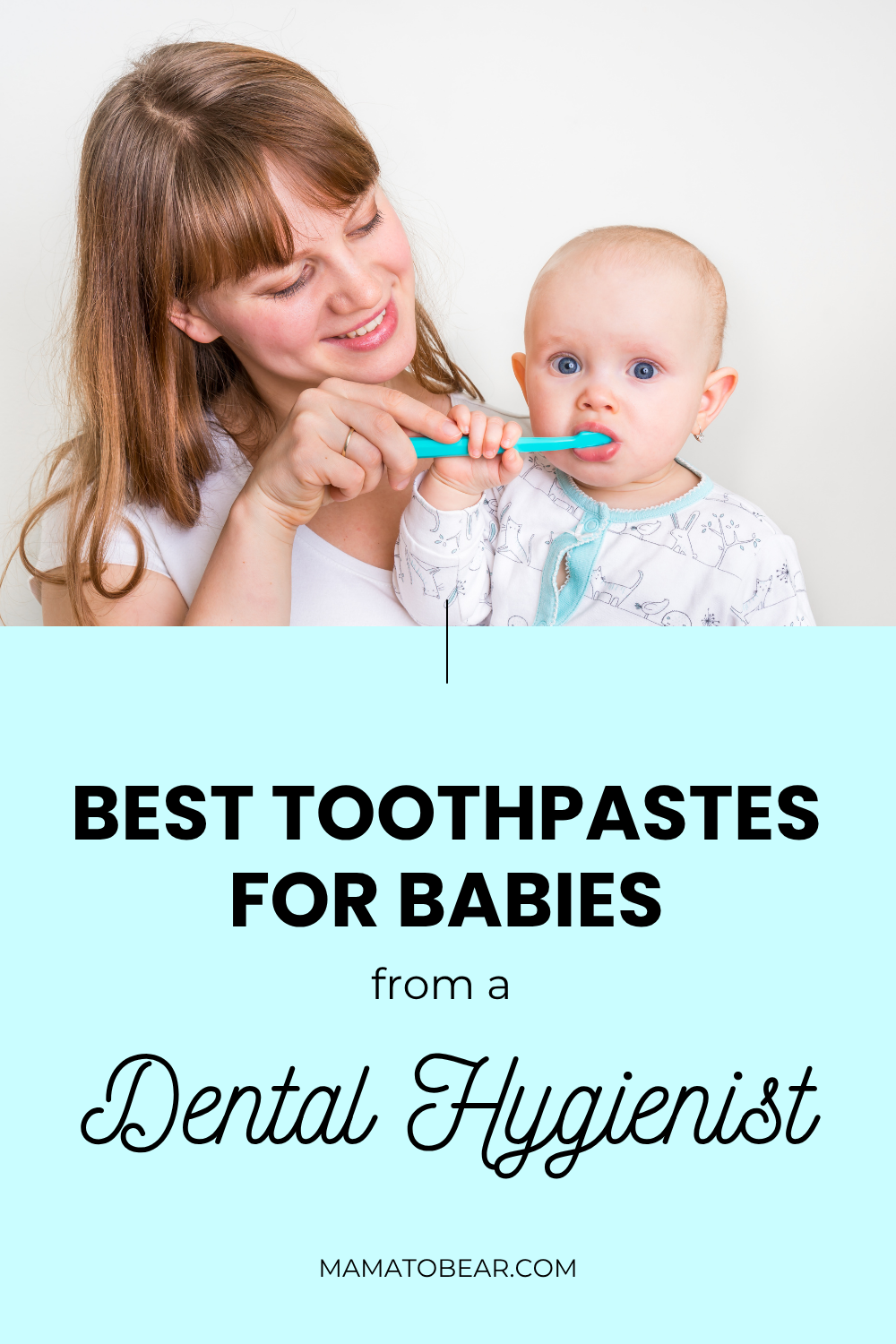
As a dental hygienist, I did a ton of research about the best toothpastes for babies once my infant developed teeth. Most of the information here I already knew from my experience in the dental field, but it brought a whole new perspective when I was the one now applying this knowledge for my baby. Choosing the best toothpaste for babies can feel overwhelming, especially when deciding between fluoride toothpaste, fluoride-free toothpaste, and newer ingredients like nano-hydroxyapatite.
One thing I’ve learned about motherhood so far is the power of choice in choosing what is best for my baby. When deciding the best toothpastes for babies, one ingredient (fluoride) often sways new parents one way or another. In young babies, the answer may not be as clear as it seems. In this post, we’re going to discuss the different types of ingredients you should and shouldn’t find in babies’ toothpaste, the use of fluoride or comparable alternatives (such as nano-hydroxyapatite), and links to specific toothpastes that meet my specific criteria as a dental hygienist and mom.
Looking for a thorough guide for babies, including the best toothbrushes and cavity-preventing advice? Check out my jam-packed complete infant dental care guide for new parents!
What Toothpaste Should Babies Use?
Besides fluoride, toothpastes contain many different ingredients. Some are beneficial, and some are not. Below are some ingredients that you should purposefully look for as well as some that you should avoid if possible when you are looking for the best toothpastes for babies.
Ingredients to Look for in Baby Toothpaste
Xylitol – Xylitol inhibits the growth of bacteria that causes cavities. Xylitol is also naturally sweet, so this eliminates the need for artificial sweeteners.
Hydrated Silica – Hydrated silica is a natural abrasive that helps scrub away plaque and food debris. It’s in some of the safest toothpastes for babies.
Nano-hydroxyapatite – Also abbreviated as nHA or nHAp, nano-hydroxyapatite is a biomimetic mineral that naturally remineralizes teeth. Our teeth already contain 97% hydroxyapatite. Nano-hydroxyapatite helps fill in discrepancies both in tooth enamel caused by acid as well as exposed dentin tubules to prevent sensitivity. In all transparency the FDA has not approved nHA yet as an anti-cavity agent, but recent studies are extremely promising. New parents can use nano-hydroxyapatite in addition to fluoride or at least use it in toothpastes that do not have fluoride. Nano-hydroxyapatite is biocompatible and therefore non-toxic if swallowed. You can read more on nAH in the section of this post that discusses fluoride.
***Fluoride – See the “Fluoride” section of this post below.
Ingredients to Avoid in Baby Toothpaste
Sodium Lauryl Sulfate – Also known as SLS for short. I prefer a baby toothpaste without SLS because it can help reduce gum irritation. SLS doesn’t have any benefit aside from making you “feel” like you’re cleaning your teeth. It’s the ingredient that causes your toothpaste to foam when you brush. You’ll also notice this ingredient is usually in soaps or other products that produce suds. Irritation to SLS is a very common issue that many of my patients encounter.
Artificial Colors or Dyes – Artificial colors and dyes are another common ingredient that cause undue irritation to the gum tissue. Some dyes are also linked to hyperactivity issues in children.
Parabens – Parabens are a class of preservatives that are in many products that we use day-to-day. It’s more than likely in our makeup, shampoo, face wash, etc. Parabens can disrupt hormones in our body. Lifelong use of parabens are linked to fertility issues in adults. As an infant, it doesn’t hurt to steer clear of this class of preservatives early in your baby’s life.
Whitening Agents – Toothpaste intended for babies should not contain any additional whitening agents. Even in adult toothpaste, whitening agents are extremely abrasive. I recommend all of my patients to steer clear of whitening toothpaste (whitening strips are fine for adults though!). Whitening toothpaste increases tooth sensitivity, increases recession, and contributes to abrasions on teeth. Each toothpaste has a rating of “Relative Dentin Abrasivity,” or RDA. This scale rates toothpastes on a scale of 0-250, with 0 being the lowest abrasive and 250 being the highest. Ideally, toothpastes for babies and toddlers should have an RDA rating of between 0-50.
Fluoride vs Fluoride-Free Toothpaste for Babies
One of the most common questions parents ask is whether fluoride toothpaste or fluoride-free toothpaste is best for babies. Below, I’m going to discuss the benefits of fluoride and risks with using too much fluoride.
Benefits of Fluoride for Baby Teeth
Dental caries (also known as tooth decay) is the most common chronic childhood disease. Around 1 in 4 children experience tooth decay between the ages of 2 and 5. This number skyrockets to around 50% in preschoolers.
We’ve known for quite some time now that fluoride helps decrease the incidence of cavities by bonding with weak parts of the enamel to make them strong again. Fluoride helps reduce the risk of tooth decay by 25%. Fluoride is most commonly found in toothpastes and public drinking water. The AAP recommends using a “smear” of fluoridated toothpaste twice a day on your baby’s teeth as soon as the first tooth appears. This “smear” should be no bigger than a grain of rice.

Risks of Too Much Fluoride
There’s two main fears that the public has about using fluoride: dental fluorosis and concerns that fluoride is a neurotoxin. I’d like to discuss both below, including how much fluoride your baby will have to consume to be at-risk of these concerns.
There are two definitions that I’d like to discuss first: systemic application and topical application. Systemic application is when fluoride is consumed, while topical application is when fluoride is applied directly to the teeth then spat out. Both conditions below can only be acquired through systemic application. Toothpaste is designed to be a topical application, however, if your child ingests the fluoride, then this once-designed topical application now becomes a systemic application.
This is why fluoride use on babies before they learn to spit can be so controversial. After your baby learns to spit in their toddler years, the use of fluoride generally becomes much easier to manage and monitor.
Dental Fluorosis
Dental fluorosis occurs when too much fluoride absorbs into permanent teeth while permanent teeth are developing under the gum tissue. It presents as a permanent “yellowing” of the teeth. Most cases of fluorosis are extremely minor and can only be noticed by a dental professional (like myself!).
Children can only acquire fluorosis if they are 8 years or younger, with the most susceptible age being between 15 and 30 months of age. After children have exceeded age 8, the enamel on their permanent teeth is fully formed under the gum tissue. After the enamel develops, it’s impossible to contract fluorosis.
How Difficult Is It To Contract Dental Fluorosis?
As long as parents stick with the rice-sized grain of fluoridated toothpaste, the risk of dental fluorosis remains minimal. Sticking to this recommendation is importance. We must assume that, in babies, they are consuming all of the toothpaste thats used since babies do not have the motor sills to “spit” just yet.
Children have a risk of contracting fluorosis if they consume more fluoride than 0.06 mg of fluoride per kilogram of body weight per day.
To get this number, convert your baby’s weight from pounds to kilograms, then multiply this number by 0.06.
For example, my 10 month old weighs 19 pounds, which is 8.6 kg. If I multiply this number by 0.06, I know that my infant shouldn’t have more fluoride than roughly 0.5 mg of fluoride per day to avoid risks of dental fluorosis.
Since we should be brushing our infant’s teeth twice daily, this number should further be halved to 0.25 mg for each time we brush.
The average adult uses about 0.75 mg to 1.5 mg of fluoride when brushing each time. This is about 3 to 6 times the maximum amount of toothpaste I should use on my baby’s toothbrush. This is why we should be using no more than a SMEAR of fluoride toothpaste on our babies before they learn to spit after brushing. As long as we use a smear, we should be able to steer clear of dental fluorosis while still giving our babies the benefit of fluoride to avoid cavities.
Neurotoxicity Caused by Fluoride
Another fear of using fluoride emerges from risk of neurotoxicity in children, causing memory issues and attention impairment in children. Studies show that consistent, extremely high consumption of fluoride can cause these impairments on children. These numbers are more difficult to calculate since studies at this time only use fluoride levels in drinking water and not in toothpaste, but I’m going to do my best to help you find a rough estimate.
How Difficult Is It To Develop Neurotoxicity from Fluoride?
Most studies that show that fluoride impacts cognitive development in children were conducted in regions where fluoridated drinking water was at or exceeded 1.5 mg/L of water. Most counties in the United States fluoridate public water systems to around 0.7 mg/L.
This number may be higher in areas where fluoride is naturally occurring. Most county fluoride levels are public knowledge. If you mainly drink well water or your source of water is not part of the public water system, you can typically contact your local government to get a water fluoride testing kit to measure the fluoride levels in your water. A grand majority of bottled water does not contain any added fluoride.
A typical child from the age of 1 to 13 consume on average from 1 to 1.7 liters of water per day, with the overall number increasing as the child ages. We can presume that the average systemic consumption of fluoride in children in these studies is 1.5 mg to 2.55 mg of fluoride daily where water is fluoridated to 1.5 mg/L of water.
My estimate is that fluoride consumption in infants would have to exceed 1.5 mg of fluoride intake for fluoridated toothpaste to have a neurotoxicity effect on children. As long as we use the same “smear” of fluoride toothpaste on infants discussed above, we mitigate these risks greatly. Even when children become old enough to use an adult-sized application of toothpaste that may contain up to 1.5 mg of fluoride, we must factor in that these children are responsibly spitting out their toothpaste when they are finished brushing.
Research is still underway for the topic of fluoride and neurotoxicity in children.
Is Nano-Hydroxyapatite a Good Alternative to Fluoride?
As stated above, fluoride can make some parents uneasy due to fear of misuse or using too much fluoridated toothpaste on their infants. If you’re uncomfortable using fluoride, a fluoride-free toothpaste for babies containing nano-hydroxyapatite may be a great alternative.
Until their child learns this motor skill, new parents may feel comfortable only using nano-hydroxyapatite. Nano-hydroxyapatite toothpaste for babies has become increasingly popular among parents looking for a fluoride-free alternative.
Nano-hydroxyapatite accomplishes very similar affects of fluoride without the worry of dental fluorosis or neurotoxicity. Additionally, nano-hydroxyapatite can be included in fluoridated toothpaste or non-fluoridated toothpaste. If you prefer to avoid fluoride until your child can spit responsibly, it is very important to ensure your child’s toothpaste contains nano-hydroxyapatite.
Best Toothpaste for Babies and Toddlers
Below are my dental hygienist-approved recommendations for the best toothpastes for babies, including both fluoride and fluoride-free options. These infant toothpastes are a great addition to your baby dental care essentials.
I will say, it was very difficult to compile a list of fluoride toothpastes that met all of my picky requirements above. If a toothpaste contains fluoride, I do not consider it necessary for that same toothpaste to contain nano-hydroxyapatite as well.
Best Fluoride Toothpastes for Babies
Hello Kids’ Natural Fluoride Toothpaste
- Has a Relative Dentin Abrasivity of 60-67
Orajel Kids Anti-Cavity Fluoride Toothpaste
- Has a Relative Dentin Abrasivity of 70 or less. The exact value is not public.
- This toothpaste does not have xylitol, which is one of my recommended products above.
Best Fluoride-Free Toothpastes for Babies
Boka Fluoride-Free Nano-Hydroxyapatite Toothpaste
- Has a Relative Dentin Abrasivity of 50
NOBS Jr. Kids Nano-Hydroxyapatite Toothpaste
- Has a Relative Dentin Abrasivity of 21
Lab52 Fluoride-Free Kids Toothpaste with Nano-Hydroxyapatite
- Has a Relative Dentin Abrasivity of 70 or less. The exact value is not public.
BURST Fluoride-Free Kids Toothpaste
- Has a Relative Dentin Abrasivity of 70 or less. The exact value is not public.
Risewell Mineral Toothpaste for Kids
- Has a Relative Dentin Abrasivity of 85
Better & Better Fluoride-Free Kids Toothpaste
- Has a Relative Dentin Abrasivity of 70 or less. The exact value is not public.
Closing Thoughts
Narrowing down the best toothpastes for babies ultimately comes down to your family’s preferences, your child’s cavity risk, and your comfort level with ingredients like fluoride and nano-hydroxyapatite. Both fluoride and fluoride-free options can play a role in maintaining healthy baby teeth when used correctly.
As a dental hygienist and mom, my biggest recommendation is to start brushing as soon as your baby’s first tooth appears and make oral care part of your daily routine. Consistent brushing habits are far more important than finding the “perfect” toothpaste, and establishing those habits early can help set the foundation for a lifetime of healthy smiles. If you haven’t checked out my complete dental care guide for infants, head there now!
Whether you choose a fluoride toothpaste for babies or a fluoride-free toothpaste for babies, the most important thing is establishing a consistent oral care routine from your baby’s first tooth.