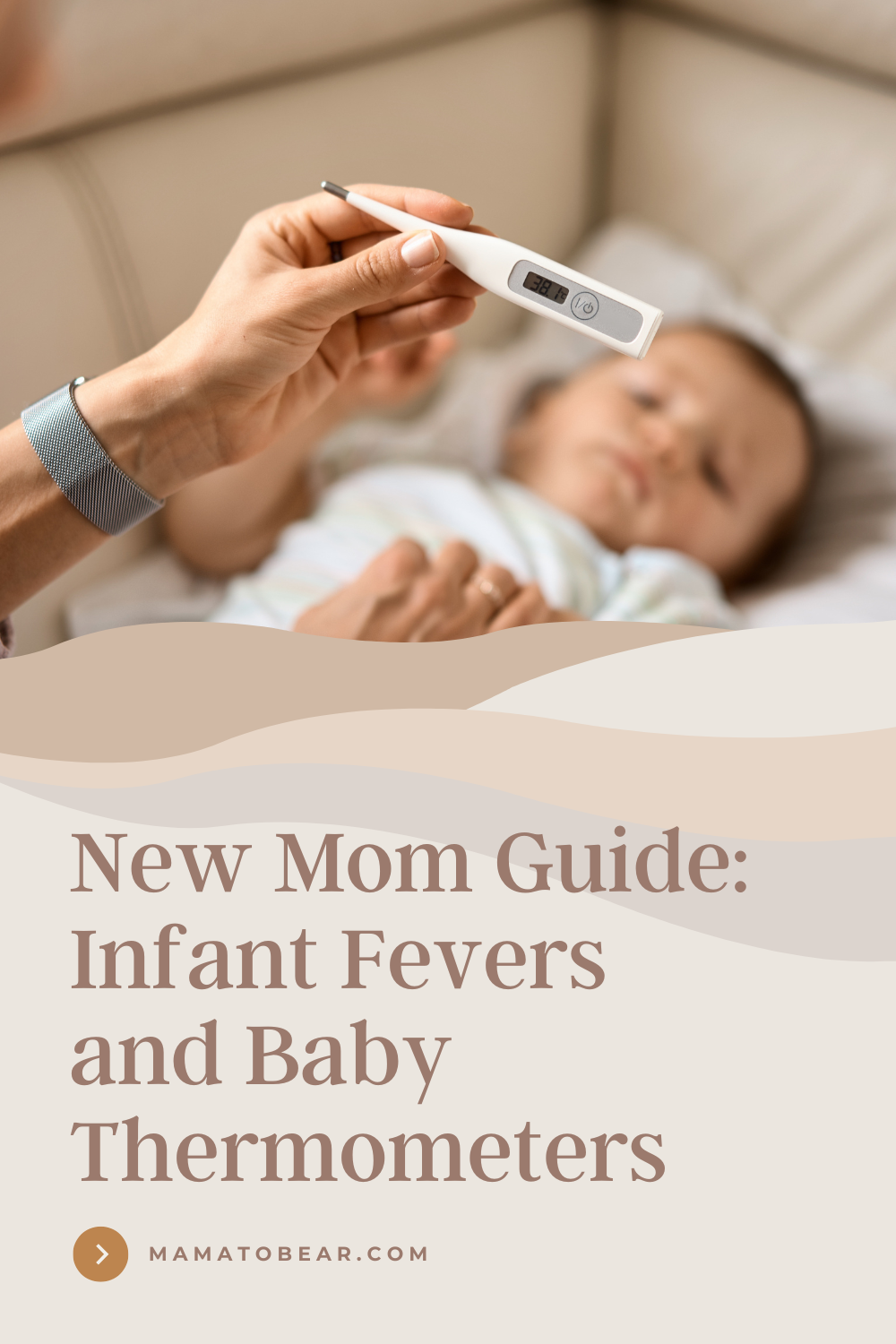
After having a baby with his first fever, I had a lot of questions about infant fevers that I didn’t consider before. Understanding how to check a baby’s temperature correctly can help avoid confusion. How high does a fever reach before an emergency room visit? Is my baby old enough to take certain medications to lower my baby’s fever? Where should I take his temperature on his body? I got two drastically different readings on two thermometers, so how do I know which one is right and which thermometer is best?
When my baby spiked his first fever of 103° at 7 months due to COVID, I didn’t think I would worry as much as I actually did. A fever in myself? I can handle it. A fever in my baby? I felt pitiful.
Read below to know what products are out there to help assess a baby’s fever, relieve it, and when to worry.
What Temperature Is a Fever in Babies?
A “core” body temperature (CBT) is your baby’s true internal body temperature. When you are deciphering whether your baby has an actual fever, you should be referring to this number. Understanding what counts as a fever in babies can help you know when to worry.
A normal CBT for a newborn or infant is anywhere between 97°F to 100.3°F (or 36.1°C to 37.9°C). A CBT of 100.4°F (38°C) or higher is a fever for both babies and adults.
I’ve heard that a baby’s temperature runs higher than adults. Is this true?
A newborn’s average CBT usually runs higher than an adult’s, but both a baby of any age range and an adult have the same “normal” temperature range.
What does this mean?
An adult’s average CBT is around 98.6°F (37°C), although recent studies are showing its actually slightly lower. A newborn’s average CBT is around 99.5°F (37.5°C). This is because a newborn’s metabolic activity is higher than those of older babies or adults (higher metabolic activity = more heat).
HOWEVER, both a baby’s and adult’s normal CBT range is the same. For both, a normal CBT range is between 97°F to 100.3°F (or 36.1°C to 37.9°C) for both newborns and adults.
CBTs read higher in the afternoons compared to in the mornings for both babies and adults. Again, this is because our metabolic activity increases throughout the day while we’re awake, thus increasing body heat.
Why do different thermometers read differently?
Different parts of our bodies give off different temperature readings because the thermometer is either reading the core body temperature or the surface skin temperature. Rectal readings are the most accurate for measuring CBT on babies because external factors such as sweat, clothing, and environmental temperatures can influence the surface skin temperature.
Factor in the type of thermometer and place of registration on your child’s body and adjust the reading accordingly when taking your child’s temperature. Depending on the type of thermometer used. it’s common for baby thermometers to give different readings. Below are the most common areas on the body to take a temperature:
Rectal (rectum) – No need to adjust. Closest to CBT.
Tympanic (ear) – No need to adjust. Closest to CBT.
Oral (mouth) – Add 0.5°F to 1°F (or 0.3°C to 0.6°C) for CBT.
Axillary (armpit) – Add 1°F to 2°F (or 0.6°C to 1.2°C) for CBT.
Temporal (forehead) – Add 1°F to 2°F (or 0.6°C to 1.2°C) for CBT.
Rectal readings are the “gold standard” for newborns and infants younger than 6 months.
What Is the Best Thermometer for Babies?
There are pros and cons to each, and having multiple different kinds of thermometers on hand is never a bad idea. Knowing how to take your baby’s temperature correctly is important. Choosing the best thermometer for your baby depends on age and comfort.
Rectal Thermometer
A rectal thermometer is the most accurate thermometer for babies under 6 months.
Pros: Considered the most accurate thermometer, especially for newborns and babies.
Cons: Can feel uncomfortable if not lubricated enough, some parents may feel nervous about using it, invasive.
Tympanic Thermometer
Usually used in babies at least 6 months old or when the ear canal is large enough to acquire a reading.
Pros: Gives a quick reading, the second most accurate way to get the closest CBT
Cons: Accuracy may be off if the ear canal is too small or is obstructed with ear wax. Can be uncomfortable, especially if fever is caused by an ear infection.
Oral Thermometer
Not the best route for babies due to difficulty placing thermometer under tongue comfortably and practically.
Pros: Good for older kids. Most accurate way if rectal reading feels uneasy for older kids and if tympanic thermometer is not available.
Cons: Eating and drinking can affect the reading.
Axillary Thermometer
Pros: Non-invasive.
Cons: Not the most accurate, usually reads lower than actual CBT. If reading seems high, confirm with one of the above methods.
Temporal Thermometer
These are also called temporal artery thermometers.
Pros: Non-invasive, quick, can be used while child is sleeping, less worry about transfer of germs due to no contact.
Cons: Room temperature, sweat, or poor angulation can influence infrared readings. If reading seems high, confirm with one of the above methods.
Continuous Monitoring Thermometers
While not recommended to be the main thermometer that gauges your baby’s fever, some may feel peace of mind when using disposable continuous monitoring thermometers. These disposable Temp-N-Toss thermometer strips adhere to your baby’s head and give a continuous reading. Momcozy’s new Wearable Digital Thermometer is rechargeable and sends notifications to your phone for fever alerts.
Again, though, these should be used in addition to at least one of the thermometers mentioned above as these are not completely reliable.
When Should You Take Your Baby to the Doctor for a Fever?
I understand not wanting to overreact and bring your baby in if it’s “nothing,” but you also don’t want your child to get worse or be miserable. That being said, when does your baby’s fever prompt an action?
When Should You Take a Baby to the ER for Fever?
- your baby is 0-3 months old and has a rectal fever of 100.4°F (38°C) or higher.
- your baby of any age has a fever of any reading in conjunction with trouble breathing, seizures, extreme sleepiness, severe dehydration (no wet diapers for 6+ hours), stiff neck, purple rash, persistent vomiting, and/or inconsolable crying.
When to Call the Pediatrician for Infant Fever
- Your baby is 3-6 months old and has a rectal fever of 102°F (38.9°C) or if a fever of any reading lasts more than 24 hours.
- Your baby is at least 6 months and has a rectal fever of 103°F (39.4°C) or if a fever of any reading lasts more than 3 days.
You know your baby more than anyone else and can sense subtle changes that may not be obvious to health care providers. Always trust your gut and call your pediatrician anyways if you are unsure of what to do.
Best Essentials and Ways to Lower a Baby’s Fever
Parents often wonder how to reduce infant fever safely and effectively. There are several safe ways to lower a fever in babies at home. Using different products or solutions are going to depend on your baby’s age. Always ask your pediatrician for the best advice on how to lower your baby’s fever.
Make sure you are keeping your baby hydrated. Fevers in babies can quickly cause dehydration, so offer breastmilk and/or formula more often to prevent dehydration before it happens. Also, your baby may want to comfort-nurse more often than usual.
Dress your baby in lightweight clothing to avoid raising your baby’s body temperature. In addition make sure the room is not overly warm. Avoid cold rooms and fans blowing directly on your baby, as this can actually make your baby shiver, and shivering produces body heat (that’s why we shiver when we’re cold!).
Bathe your baby in a lukewarm bath. Don’t use ice or place baby in a cold bath either. Again, these things can cause shivering which can raise body temperature even more.
If the fever is caused by a virus or bacteria that also causes congestion, consider using these vapor bath drops or vapor bath balms in the bath to help clear up your baby’s sinuses at the same time.
Fever cooling patches may offer some relief for infants as well. Infants lose most of their heat through their heads.
What Medications are Best to Reduce a Fever in Babies?
Tylenol is one of the most commonly used fever reducers for babies. Tylenol can often be given to babies at least 3 months old, but your pediatrician may approve the use of Tylenol if your child is even younger on a case-by-case scenario. Remember, though, that if your baby is younger than 3 months, a fever of any kind usually prompts an emergency room visit.
Ensure you are using the correct dosage of medicine for your baby’s age and weight. Tylenol can be given every 4 hours, not to exceed 5 doses in 24 hours. Always ask your pediatrician before giving fever medicine to infants.
Motrin can be given to babies at least 6 months old and can usually reduce fevers that Tylenol may not reduce alone. Again, make sure you are using the correct dosage of medicine for your baby’s age and weight. Motrin can be given every 6 hours, not to exceed 4 doses in 24 hours. Again, always ask your pediatrician before giving fever medicine to infants.
Many pediatricians recommend alternating between Tylenol and Motrin every 3 hours as a common routine to help alleviate a fever in babies . In other words, administer Tylenol, then 3 hours later administer Motrin, then 3 hours later administer Tylenol again, etc.
This helps avoid accidental overdosing in babies as well as makes sure your baby has something in his or her body around the clock without having to worry about excess dosages in the allotted 24 hours. (Also, juggling two different medications at different dosing intervals can quickly get confusing and overwhelming.)
However, if your baby’s fever is due to the stomach bug or another sickness where its difficult to keep liquid medicine down, FeverAll acetaminophen suppositories may be a better option for you if your baby is at least 6 months old.
Interested in other medicines I keep on hand? Read the other essentials I keep in my infant’s medicine cabinet and first-aid kit.
Final Thoughts on Infant Fevers and Thermometers
Infant fevers can feel overwhelming, especially for first-time parents, but having the right thermometer and knowing when to seek medical care can make a huge difference. Understanding normal baby temperatures, fever symptoms, and safe ways to lower a fever can help you feel more prepared and confident the next time your baby gets sick.